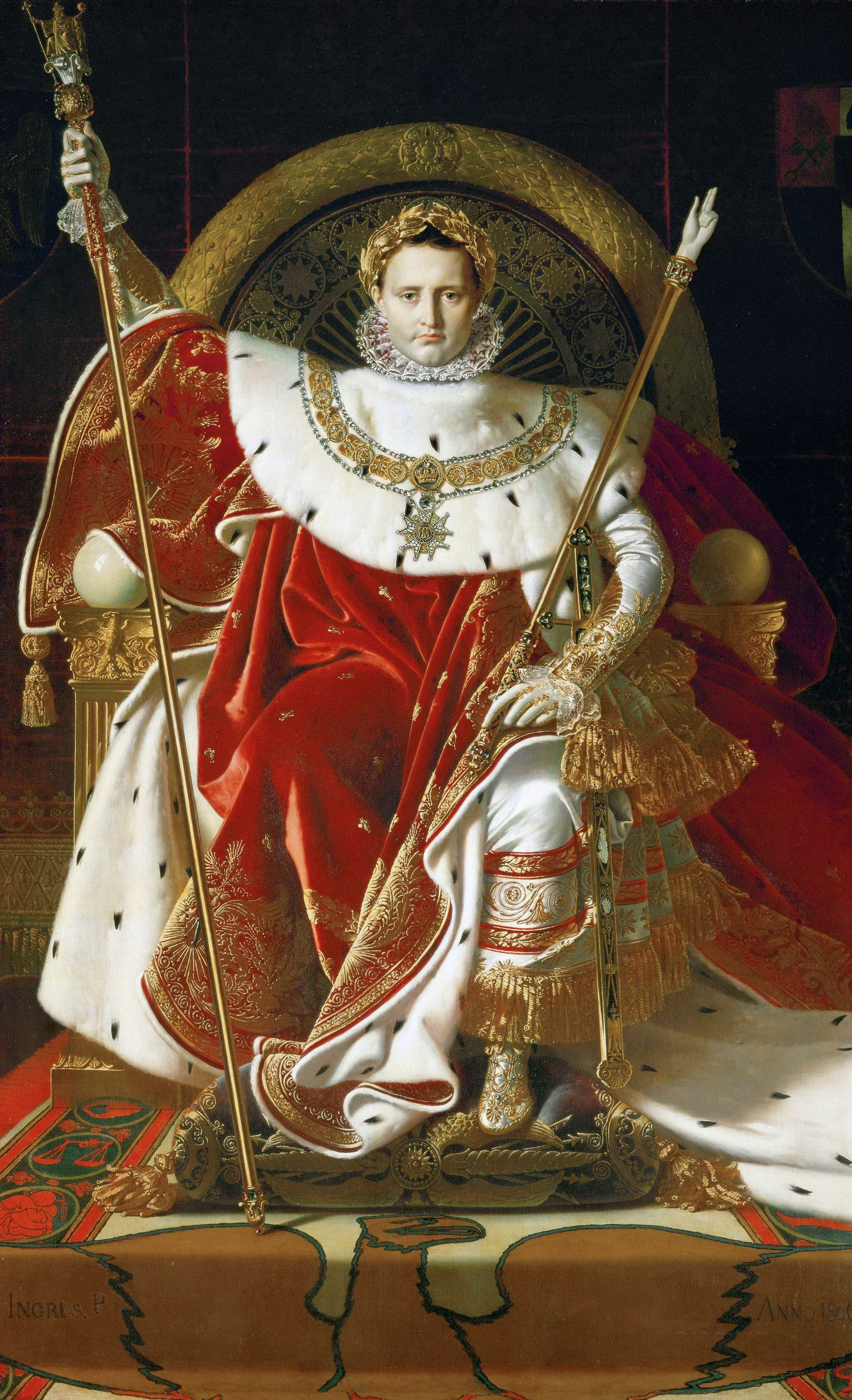
In 1806, when Jean-Auguste-Dominique Ingres exhibited this painting, Napoleon I on his Imperial Throne, critics in Paris were horrified.
They called it “barbaric,” “Gothic,” and “regressive.”
Why? Because it looked nothing like the “modern” portraits of the time. Napoleon is so swathed in layers of velvet, gold, and jewels that he resembles a medieval icon rather than a man of the Enlightenment. He is almost unrecognizable as a human being.
But this is exactly what Napoleon wanted. He did not need to be loved as a man; he needed to be worshipped as a god.
Why the Bees?
Amidst the dense symbolism of the painting, the most intriguing detail is the swarm of golden bees covering his robes.
When Napoleon was preparing for his coronation, he faced a massive PR crisis: How does a Corsican general make himself look like a “chosen one”? He couldn’t use the Fleur-de-lis (lily), as that was the symbol of the hated old regime he had just replaced.
His advisors dug through the dust of history and found the perfect alternative.
In 1653, workers discovering the tomb of Childeric I (a king of the Merovingian dynasty, the “first race” of French kings) found over 300 golden winged insects. Though later identified by archaeologists as likely being cicadas, at the time, they were interpreted as bees.
It was a godsend of political propaganda.
- Antiquity: The Merovingians predated the Bourbons by over a thousand years. By using bees, Napoleon implied his power “skipped” the corrupt recent kings and connected directly to France’s most ancient ancestors.
- Industry and Obedience: Bees symbolize organized industry, diligence, and absolute loyalty to the monarch.
Calculated Divinity
Ingres’ painting may have been hated by critics, but it perfectly captured Napoleon’s ambition.
If you look closely, Napoleon’s pose—frontal, seated, holding scepters in both hands—is an almost exact copy of the famous depiction of God the Father in the Ghent Altarpiece, or the ancient statue of Zeus at Olympia.
There are no flaws, no personality, no “humanity” left. Beneath that heavy armor of gold and gems, the man has vanished. All that remains is a concept:
The Empire.
Conclusion
Napoleon eventually fell, and his empire crumbled. But in this painting, through the golden laurel wreath, the ancient bees, and the sacred scepters, he successfully froze himself into eternity.
Like all great tyrants and visionaries, he knew that jewelry is not just wealth. Because it is hard, brilliant, and unchanging, it is the perfect material for forging immortality.