In the history of jewelry, no luxury object carries as much historical weight and emotional resonance as the Fabergé Eggs.
They were the annual Easter gifts from Tsars Alexander III and Nicholas II to the two most important women in their lives—Empress Maria Feodorovna and Empress Alexandra Feodorovna. From 1885 to 1917, these 50 Imperial Eggs were not just the pinnacle of craftsmanship, but the final glory and requiem of the Romanov dynasty.
🥚 1885: The First Hen Egg
It all began with Easter in 1885. To comfort Empress Maria (formerly Princess Dagmar of Denmark), who was suffering from homesickness and depression, Tsar Alexander III commissioned a special Easter egg from Peter Carl Fabergé.
The “Hen Egg” looked simple enough: a white enameled shell, like a real egg. But when opened:
- Inside was a matte gold “yolk”.
- The yolk opened to reveal a golden hen.
- Inside the hen (now lost) was a miniature diamond replica of the Imperial Crown and a ruby pendant.
The Empress was so delighted by the layers of surprises that Alexander III appointed Fabergé as the “Goldsmith by Special Appointment to the Imperial Crown”. The Tsar gave him only one standing order: “There must be an egg every Easter, and each must contain a unique surprise.”
🏰 1897: The Coronation Egg
After Alexander III’s death, his son Nicholas II continued the tradition. He now had to commission two eggs each year: one for his widowed mother and one for his new wife, Alexandra.
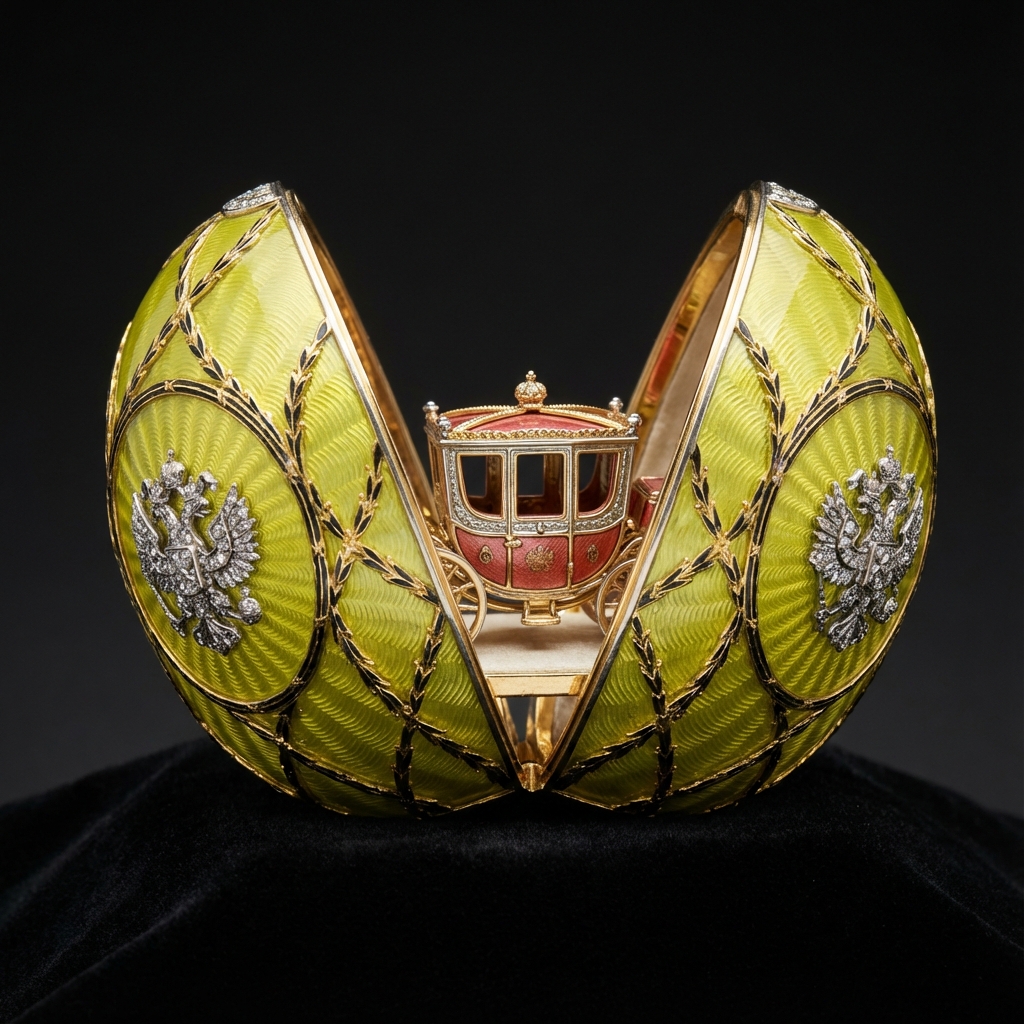
The Coronation Egg (pictured above) is widely considered Fabergé’s most celebrated masterpiece.
It commemorated the 1896 coronation of Nicholas and Alexandra in Moscow. The surprise inside—the miniature coach—is an exact replica of the carriage used by Catherine the Great, which Alexandra rode in. It is said that Fabergé’s craftsmen visited the Imperial stables daily to study the original carriage, spending months working under microscopes to ensure the tiny wheels could actually turn.
🥀 1916: War and Steel
As World War I raged and Russia’s internal stability crumbled, the use of luxury materials became politically sensitive.
In 1916, Fabergé created the “Order of St. George Egg” for the Dowager Empress. It had no diamonds or gold. It was made of simple white enamel, decorated only with the Cross of St. George (the highest military honor, which Nicholas II and Tsarevich Alexei had just received at the front).
This modest egg was a mother’s prayer for her son and grandson at the war front. By this time, most of the Fabergé workshops had been converted to produce hand grenades and artillery shells.
🔚 1917: The Unfinished Swansong
In 1917, the February Revolution forced the Tsar to abdicate. Fabergé was in the middle of creating that year’s two eggs:
- The Birch Egg: For the Dowager Empress, made of Karelian birch, symbolizing the Russian land.
- The Constellation Egg: For Alexandra, made of dark blue glass, engraved with the star map of the Tsarevich’s birth.
These eggs were never delivered. The Romanov family was imprisoned and eventually executed in a basement in Yekaterinburg. The Fabergé family fled to Switzerland, leaving these masterpieces to be scattered by the winds of history.
💎 Epilogue
Fabergé eggs are more than just jewelry; they are miniature installation art, marvels of mechanical engineering, and a private photo album of a doomed dynasty.
When we gaze upon the glittering Coronation Egg, we see not just diamonds and enamel, but the fading silhouette of an empire that was once magnificent, yet destined for destruction.
Collector’s Note: There are only 50 “Imperial Eggs” (43 survive). Almost all “Fabergé” egg pendants sold today are modern licensed products or imitations. If you see a real one in a museum, look closely at the Guilloché Enamel—a technique where thousands of intricate lines are engraved into the metal before being covered with translucent glass, creating a mesmerizing, holographic glow.