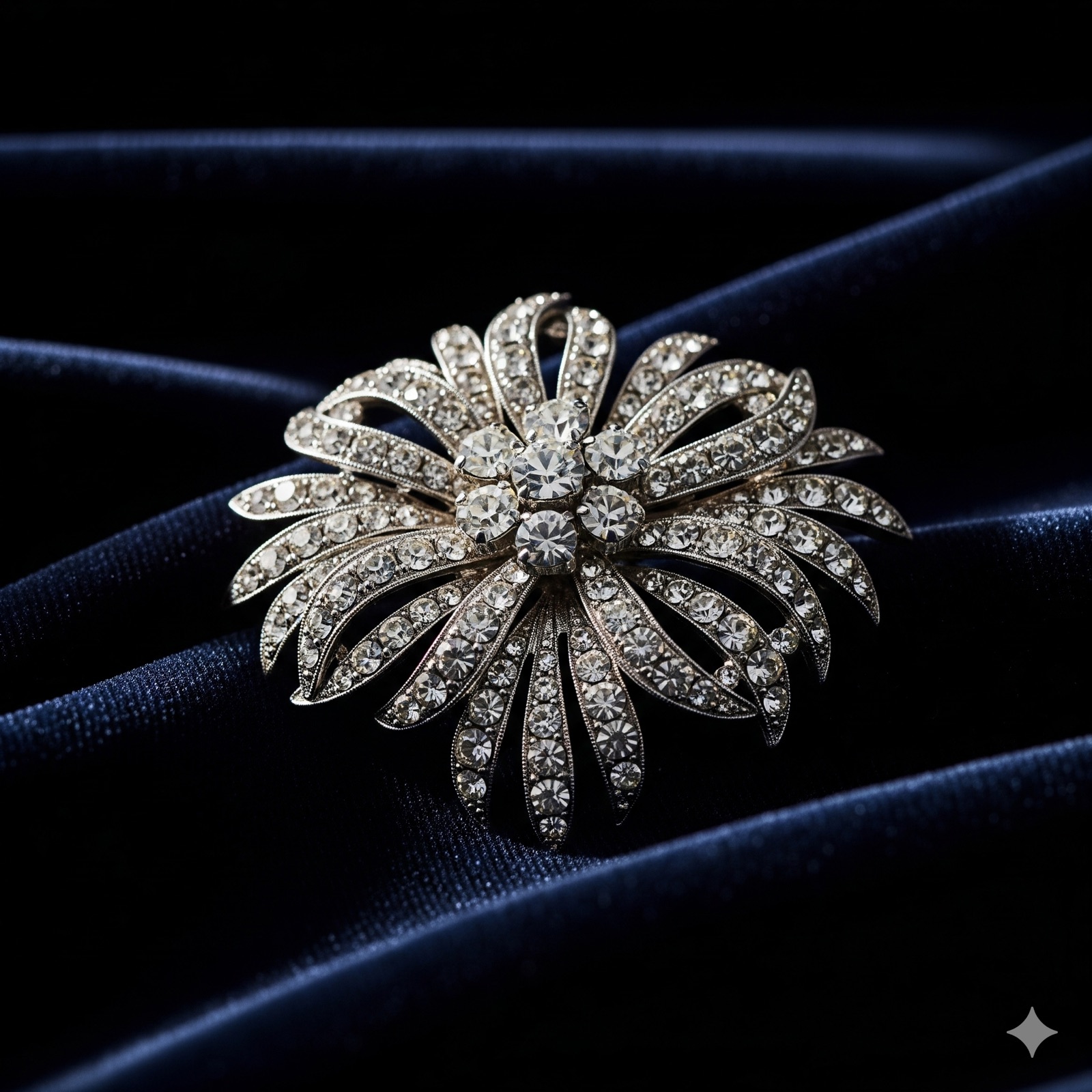
In Rarequiste’s collection concept, material does not determine everything. Design & Craftsmanship are eternal.
The United States in the 1930s-1950s was in the recovery period after the Great Depression and World War II. People couldn’t afford expensive jewelry, but the desire for beauty never stopped. Thus, Costume Jewelry came into being. It does not use precious metals, but uses Base Metal, Rhinestone and Glass to create works more imaginative than real gold and silver.
Among them, Trifari and Coro were the twin stars of that era.
👑 Trifari: Soul of Cartier, Affordable Price
If you see a brooch marked Trifari in an antique shop, and the design is as exquisite as high jewelry, it is likely from the hand of Alfred Philippe.
This designer, who had worked at Cartier and Van Cleef & Arpels, brought the Invisible Setting of high jewelry into the field of costume jewelry.
Series Worth Collecting:
- Fruit Salad: Using colorful Molded Glass to imitate rubies and sapphires, it is Trifari’s most sought-after series, with prices often reaching thousands of dollars.
- Crown Trifari: With a small crown above the logo, representing works from the golden age of 1930s-1950s.
- Jelly Belly: Using transparent Lucite resin as the animal’s belly, the craftsmanship is extremely complex, and it is now a museum-level collection.
🕊️ Coro: Ingenious Mechanisms
Compared to Trifari’s elegance, Coro (and its high-end line CoroCraft) wins in structure and fun.
Duette Mechanism
Coro’s most famous patented design is Duette. It is an ingenious metal frame that can combine two small Dress Clips into a large brooch. One piece of jewelry, two ways to wear, this mechanical beauty makes collectors like R with a “science and engineering man” perspective fond of it.
🔍 Identification Tips: Material Speaks
- Pot Metal: A gloomy alloy commonly used in the 30s, heavy to the touch, a feature of early good goods.
- Sterling: During World War II (1942-1945), because base metals like copper and tin were used to make ammunition, jewelers were forced to use sterling silver as the base material. If you see a Costume Jewelry marked
Sterling, it must be a product of the WWII period and has great historical value.
At Rarequiste, we believe: A perfect rhinestone is far better than a mediocre diamond.